More than 20 percent of toilets leak9,300 gallons a year to household leaks
How to check your home for a hidden water leak
Two tests catch most household leaks, and neither one needs a tool or costs a dollar. This guide walks through the meter check and the toilet dye test, then explains what each outcome means.
- The meter test in four steps
- What the dye test proves
- SNWA $250 leak voucher

Turn off everything that uses water, then watch the meter's flow indicator for two minutes. Movement means water is leaving the system. Follow it with a dye test in each toilet tank. The Southern Nevada Water Authority reports that more than 20 percent of toilets leak, almost always silently.
Last updated 2026-09-03. Written for homeowners in Las Vegas and Clark County, Nevada.
How do you know a hidden leak is there at all?
Most hidden leaks announce themselves on paper before they show up on a floor. A bill that rises while nothing about the household changed is the single most common first clue.
The Environmental Protection Agency's WaterSense program puts average household leak waste above 9,300 gallons a year. The same program estimates that fixing the easy leaks trims a water bill by roughly 10 percent.
Other clues are sensory rather than financial. A toilet that refills on its own and a faint hiss in a quiet room both qualify. So does a warm spot underfoot, or a patch of yard that stays green through August.
None of those confirm anything by themselves, which is the point of testing. The two tests below turn a suspicion into a plain yes or no, and the meter does most of the work.
How do you read the meter to test for a leak?
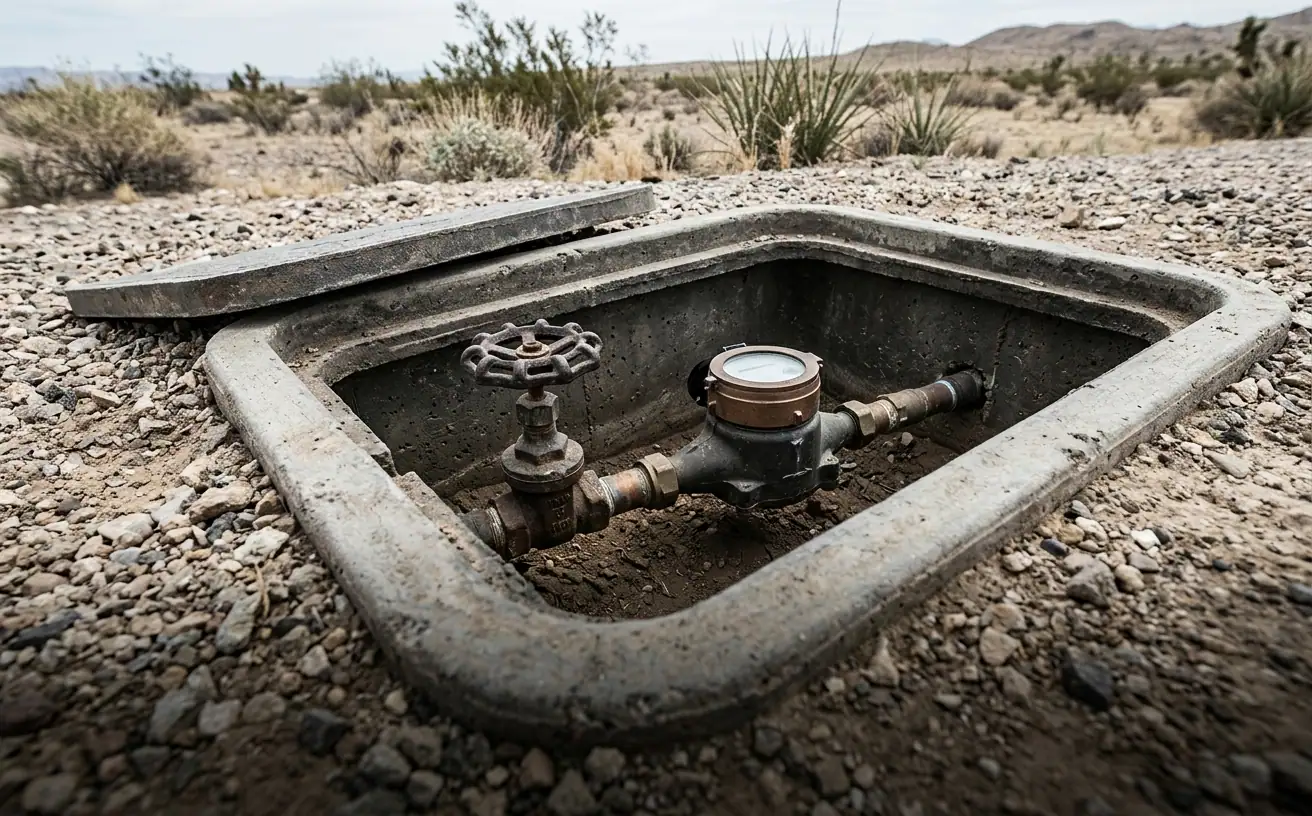
The meter test is the one diagnostic a homeowner can run safely, and it costs nothing. The meter usually sits in a concrete box near the curb, under a metal or plastic lid.
Lift the lid carefully. Valley meter boxes are a favorite shelter for insects and the occasional snake, so look before reaching. Wipe the glass and find two things: the numbered register that counts total usage, and a small triangle, star or dial called the flow indicator.
Shut off everything that uses water. That means every faucet, the dishwasher, the washing machine, the ice maker, any evaporative cooler, and the irrigation controller. Then watch the flow indicator without touching anything for two full minutes.
If the indicator turns at all, water is moving through the meter while nothing is on, which is a leak by definition. If it stays perfectly still, write down the register numbers, use no water for two hours, and read it again.
A register that has changed after two hours with a motionless indicator means a slow leak. The indicator is simply too coarse to catch a trickle, and the register is not.
| Test result | What it points to |
|---|---|
| Flow indicator turns with everything off | Water leaving the system continuously |
| Register moves over two hours, indicator still | A slow leak, most often a toilet flapper |
| Neither the indicator nor the register moves | No leak past the meter at this moment |
| Indicator still turns after closing the main shutoff | A leak between the shutoff valve and the meter |
| Soft ground or a green patch over the line | An irrigation or service line leak underground |
| Bill up, meter still, ground dry | An estimated read or a genuine change in use |
How do you dye test a toilet?
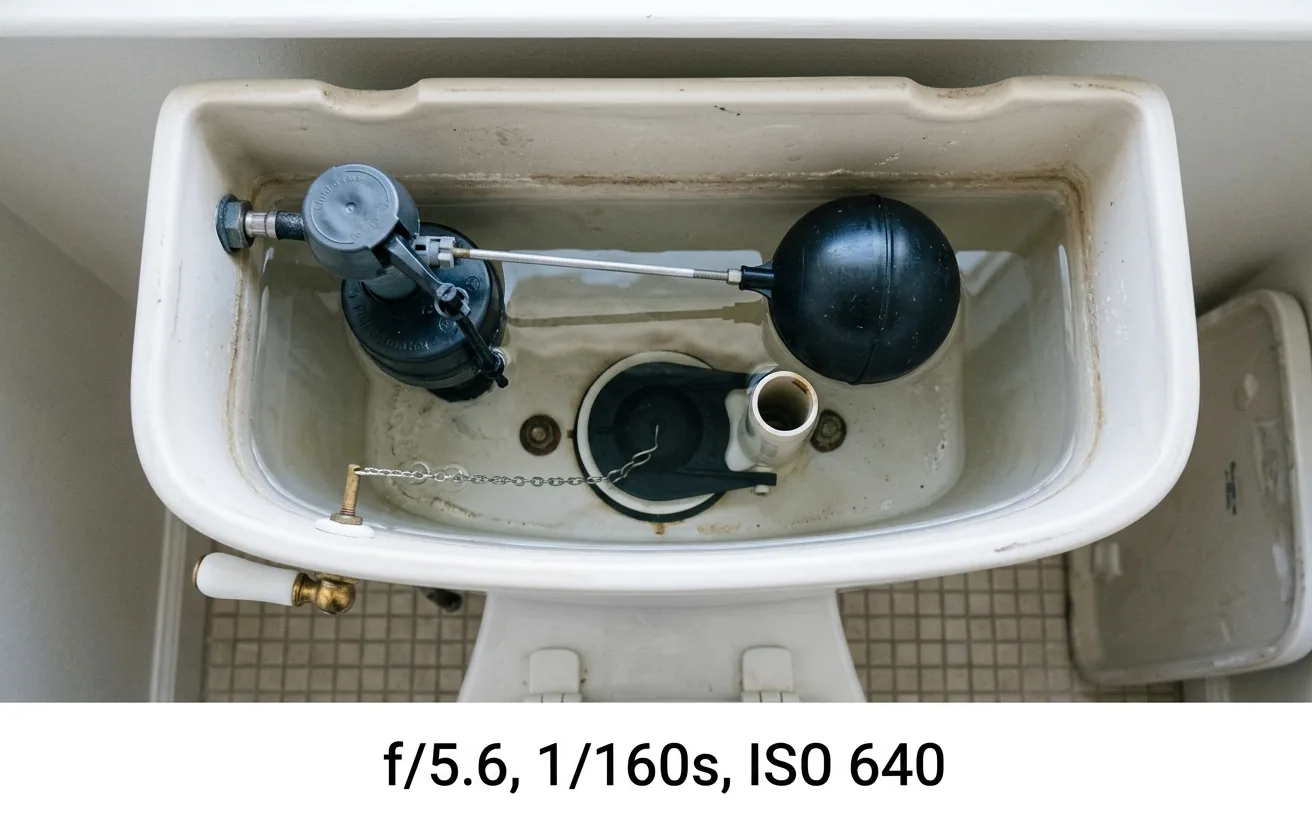
Toilets are the most common hidden leak in any house, and the Southern Nevada Water Authority reports that more than 20 percent of them leak. Almost all of those leak silently, because the water runs down the overflow tube and straight into the bowl.
The dye test needs nothing but food coloring and a little patience. Lift the tank lid and set it flat on a towel, because the porcelain lid cracks easily and is not cheap to replace.
Put several drops of food coloring into the tank water, then leave the toilet completely unflushed for twenty minutes. Do not use the bathroom during that window, since one flush resets the whole test.
Come back and look into the bowl. Colored water in the bowl means the flapper at the bottom of the tank is no longer sealing. Treated water has been running to the sewer around the clock.
Repeat it in every toilet in the house. A home with three bathrooms can easily have two good flappers and one bad one, and the bad one is the entire bill increase.
Where do hidden leaks actually hide in a valley home?
Irrigation is the biggest offender here, and it hides well because it runs before dawn. A cracked lateral or a weeping valve waters the soil instead of the plant. The only visible clue is a soft or unusually green patch.
Under sinks, the angle stops are the usual suspects. They weep at the packing nut rather than dripping, so the first sign is a crust of dried mineral on the valve body. InterNACHI rates those small shutoff valves at 8 to 20 years.
A water heater can weep from a fitting for months before anything obvious appears. Look at the floor around the base and inside the pan, and look for rust streaks and mineral crust rather than standing water.
Pressure is the quiet cause behind several leaks at once. A failed pressure regulator lets full street pressure into the house, and every fixture, hose and connection then works harder than it was built to.
The fourth row of the table above is the one to take seriously. The Southern Nevada Water Authority states the rule plainly. If the flow indicator keeps moving with every tap off, the leak is most likely underground between the shutoff valve and the meter.
What happens next, and what help is available?
Southern Nevada has a program aimed at exactly this situation. The Southern Nevada Water Authority offers single family homeowners a voucher of up to $250. It goes toward a leak diagnostic visit, or toward the first two hours of leak repair.
It runs through a participating Water Smart Plumber, and it is limited to one per property per calendar year. The current terms and participant list live on the Water Authority's own rebates page.
Permits are rarely an obstacle for this kind of work. Clark County Code 22.02.195 lists repairing leaks in pipes, valves or fixtures as work needing no permit. Stopping leaks in drain, soil, waste or vent pipe is on the same list.
If the leak turns out to be under the concrete, that is a different search. The guide on signs of a slab leak covers what those symptoms look like and how they get confirmed.
If your meter test came back positive, the leak Detection, Las Vegas NV explains how the location gets narrowed down without opening walls. Call (725) 337-3692, say what the meter did and how long the bill has been high.
Sources
- More than 20 percent of toilets leak, the flow indicator rule for a leak between the shutoff and the meter, and the voucher of up to $250 Southern Nevada Water Authority
- Average household leak waste above 9,300 gallons a year, and about 10 percent off a bill when easy leaks are fixed EPA WaterSense
- Angle stop shutoff valves rated at 8 to 20 years InterNACHI life expectancy chart
- Repairing leaks in pipes, valves or fixtures and stopping leaks in drain, soil, waste or vent pipe need no permit Clark County Code 22.02.195
- Hardness of 16 grains per gallon in valley tap water LVVWD Water Quality Summary
- The sewer lateral from the house to the main in the street is the property owner's responsibility Clark County Water Reclamation District
Where to go from here
Want someone to look at yours?
Reading about it only gets you so far. One call gets you an answer about your house.
Reach Clark County Plumber
- Phone
- (725) 337-3692
- Service area
- Clark County, Nevada, including Las Vegas, Henderson, North Las Vegas, Summerlin, Paradise, Spring Valley, Enterprise and Boulder City
We are a service area business. We come to you, so there is no counter to visit and no street address on this page. The number above is the fastest way in.
What to have ready
About a minute of detail changes what we can tell you on the call.
- The address and ZIP code, so we know which end of the valley you are on.
- What the symptom is, in your own words. "Water under the sink" beats a diagnosis.
- When it started, and anything already tried.
- On a water heater: gas or electric, and roughly how old it is.
- You get the diagnostic fee as a figure on the phone, before anyone is sent.
- Scope and price are agreed together, before any work starts.
- Water moving right now? Shut the main off first, then call and say so.
Related questions
My bill doubled but the meter is not moving. What now?
Run the two hour register check before anything else, because the flow indicator misses slow losses. Write the numbers down, use no water at all for two hours, and compare. A changed register with a still indicator is a trickle rather than a gush.
If both stay put, the next questions are whether the read was estimated and whether irrigation run times changed for summer.
Can I just wait and see if it settles down?
Waiting costs more than it saves. Water under pressure enlarges whatever opening it found, so the loss grows rather than stabilizing, and the bill follows it upward month by month.
There is also damage to consider. A leak inside a wall or under a floor feeds drywall, framing and flooring the entire time. That repair is far larger than the plumbing one.
How much water does a running toilet actually waste?
Enough to explain most unexplained bills on its own. A failed flapper does not drip or run in bursts, it passes a steady stream into the bowl and makes no sound doing it.
Nothing about it registers as a problem until the bill arrives, which is exactly why the dye test exists. A few drops of food coloring settle the question for good.
Do I need to be home for a leak check?
Yes, in almost every case. A leak check needs access to fixtures inside the house, the water heater, the main shutoff and the meter. The plumber also has to turn water on and off while testing.
Being there also shortens the visit. The symptom you noticed, and where in the house you noticed it, narrows the search immediately.
Is the leak my responsibility if it is out near the street?
On the sewer side the answer is settled. The Clark County Water Reclamation District treats the lateral as the property owner's to clean, repair and replace. Its own responsibility starts at the main.
On the water side, watch the flow indicator after the main shutoff is closed. If it keeps turning, the leak sits in the buried section between that valve and the meter.
Talk it through with someone
Describe what you are seeing and we will tell you what it usually turns out to be.