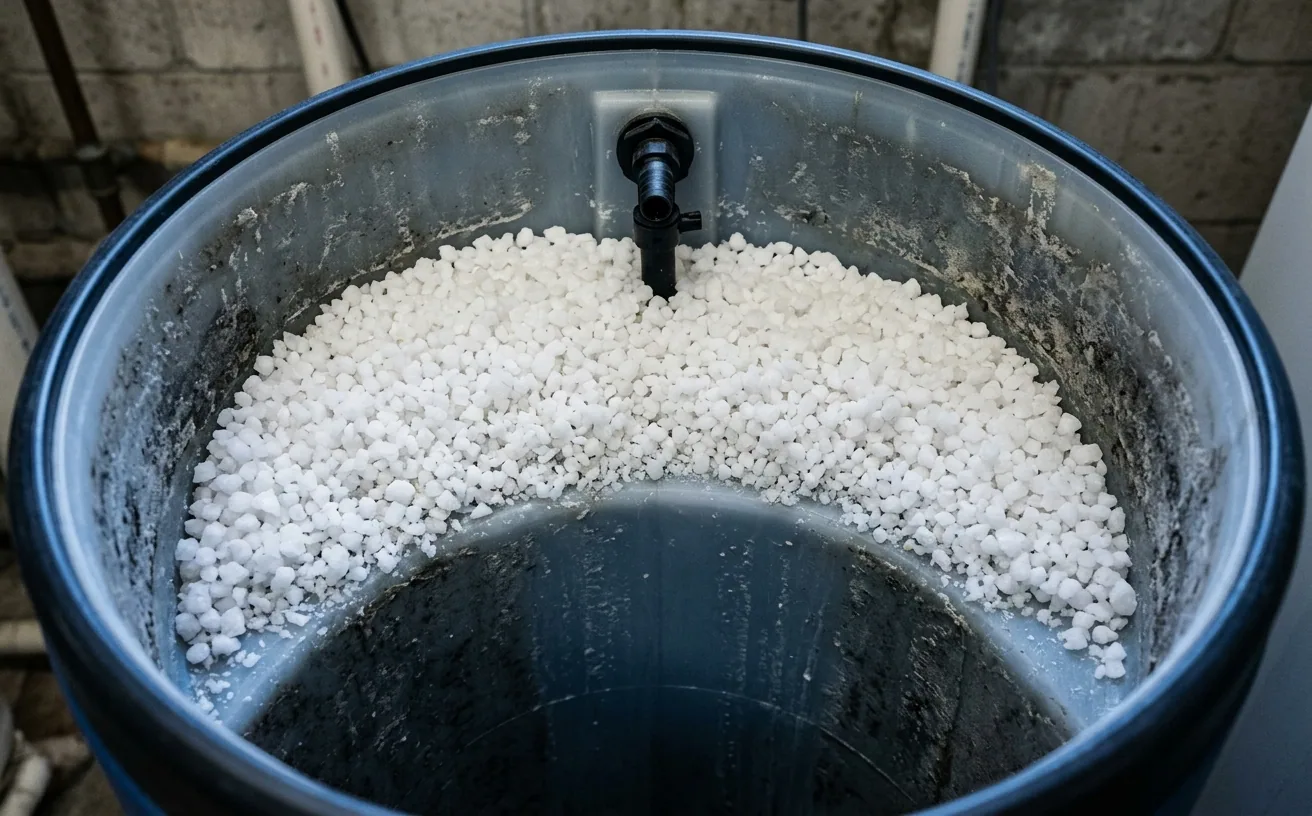
A brine tank that is full but useless
Salt can cement into a solid arch spanning the tank, with an air gap beneath it. The tank looks full from above while no brine is made underneath. Tapping the crust with a broom handle collapses it.
Diagnosis before parts are orderedNot limited to any one brandLas Vegas Valley and Clark County
A softener that stopped working rarely announces which part failed. Hardness climbing back toward the published 16 grains per gallon is the symptom, not the cause.
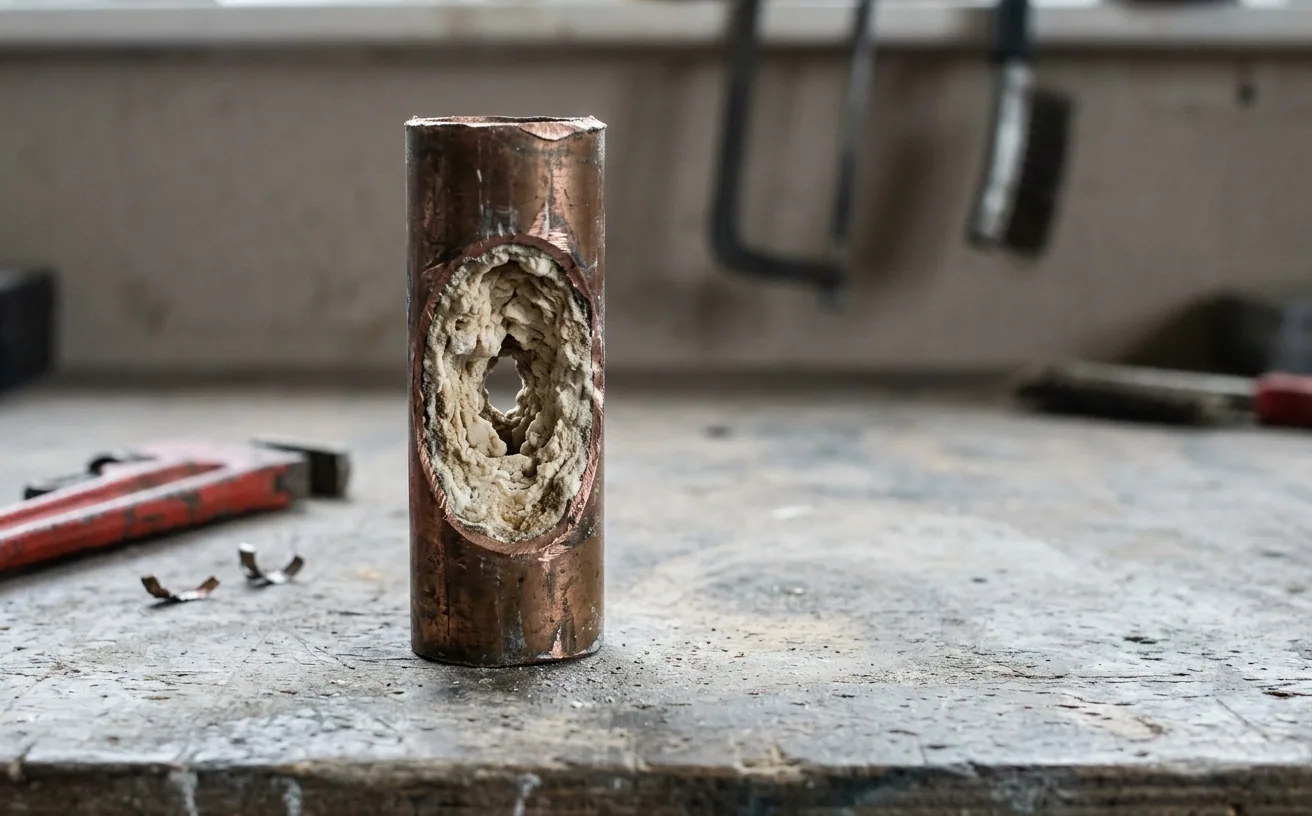
Figures above are published third party data, not company claims. Sources: LVVWD Water Quality Summary, Water Quality Association, LVVWD Water Quality Report, LVVWD Water Quality FAQs.
When a softener stops softening, the cause is usually one of six things. A bypass lever left open, a lost clock setting, a salt bridge, a blocked injector, a stuck valve piston or a spent resin bed. Diagnosis starts with a hardness test at a treated and an untreated tap.
This page covers water softener repair across the Las Vegas Valley. If you are not sure this is the right service, start from the services index.
Softener faults sort into two groups. Either the unit is not treating the water, or the unit is making a mess. Which group you are in changes the whole diagnostic path.
Say the symptom in plain words when you call. Three facts help most. Whether the salt level is dropping, whether water is standing in the brine tank, and what the head is displaying.
This page fits a unit that is physically present and misbehaving, at any age. A repair is usually the right first move on a system under about ten years old.
It also fits a unit you inherited with the house and have never touched. Plenty of those turn out to be bypassed or unplugged rather than broken.
If the tank is split, or the unit is past fifteen years with a second failure, the comparison belongs on softener replacement across Clark County. If there was never a softener here, start at water Softener Installation in Clark County, NV.
Water on the floor is not always the softener. If it traces back to the wall, the slab or the heater, see leak detection service in Southern Nevada or water Heater Repair for Las Vegas homes. Salt levels and cleaning belong on water softener maintenance.
These are the patterns that come up most often on residential units here. None of them is a diagnosis without a look at the equipment. They tell you what a plumber will be checking.
| What you are seeing | What it usually points to |
|---|---|
| Salt level never drops | The unit is either not regenerating at all, or it is sitting in bypass. A lever left in the bypass position after past service is the most common cause of a softener that appears dead. |
| Hard water returns between cycles | Three suspects share this one. The hardness setting may have drifted off 16 grains per gallon. The salt dose may be too small, or the resin may be losing capacity with age. |
| Standing water in the brine tank | This points to a blocked injector, a stuck brine valve or a restricted drain line. All three stop the unit drawing brine back out during regeneration, so the salt never gets used. |
| A crust of salt with a void underneath | That is a salt bridge. Salt has cemented into an arch over empty space. The water below never touches salt, so no brine is made even though the tank looks full. |
| Regeneration every single night | A lost or wrong clock setting after a power interruption is the usual answer. A failed meter head behaves the same way, reverting to a fixed time schedule instead of metering real use. |
| Dripping at the control head | Valve seals and the rotor or piston wear over time, and hard water speeds that up. A leak at the head is often a seal and spacer kit rather than a whole new valve. |
| Gritty beads in the plumbing | Resin beads reaching a faucet aerator mean the distributor or screen inside the tank has failed. This is one of the few faults that genuinely does push toward replacement. |
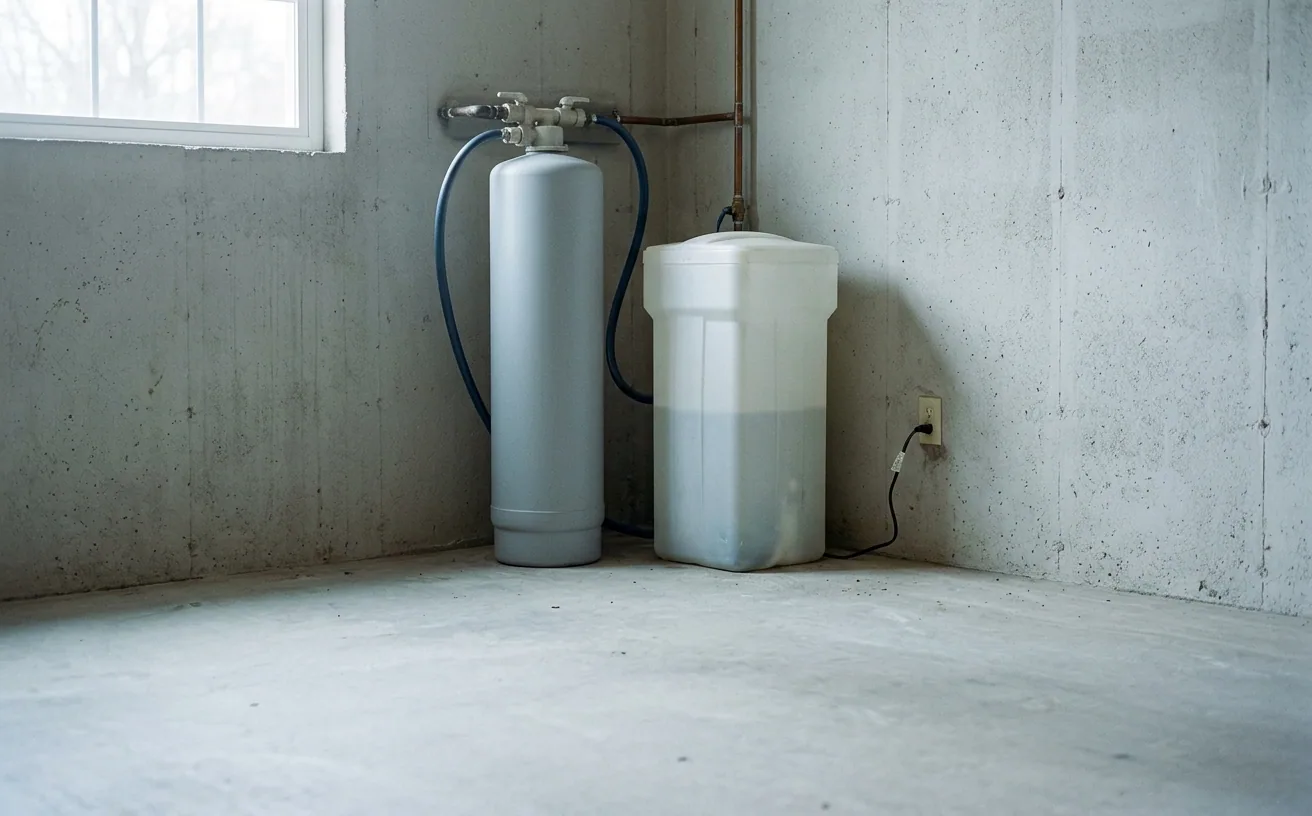
The order matters, because the quick checks eliminate the expensive suspects.
You say what changed and when. We ask whether the salt is dropping, whether there is water in the brine tank, and what the head displays. That narrows the causes before anyone drives out.
On the phoneYou show an untreated outside spigot and a treated inside tap. A plumber tests both. The readings show whether the unit is doing nothing, part of the job, or working fine while something else is blamed.
First on siteYou get the answer immediately if it is one of these. A plumber checks the bypass position, the power, the clock, the programmed hardness, and the salt for bridging. That order is deliberate.
Before anything is openedIf the quick checks pass, a plumber isolates the unit and opens the control head. The injector, screen, piston, seals and brine valve get inspected. The drain line is checked for restriction too.
Same visitYou are told what the repair involves and what the parts cost. You are also told plainly if the unit is too old for a repair to be a good bet. Nothing is fitted until you say go.
Before any part is installedThe repair price is final once the valve has been opened and the failed part is identified. That is the first moment anyone can quote it honestly.
Repair is the one job on this site where the price is unknown until the valve is open. The published ranges below come from the source named next to each one, and they describe the market rather than an invoice.
Softener repair has an unusually wide published spread. A seal kit and a full valve rebuild are both called a repair. Where your job lands depends on which part failed.
Nobody can price this accurately over the phone, because the failed part is not visible until the head is opened. What we can do on the phone is say which faults are cheap and which are not.
On site the diagnosis comes first and the price comes second. You are told the figure and what it covers before a part is fitted. You can decline and pay only for the diagnostic visit.
| Job | Typical Las Vegas range | What moves the number |
|---|---|---|
| Water softener repair | $162 to $982 | Average about $557. Simple fixes start around $65 and a full valve rebuild runs to about $2,545. |
| Service call or diagnostic fee | $75 to $150 | The broader trade range runs about $50 to $200. Emergency and after hours dispatch is higher, commonly $150 to $350 or more. |
| Water softener, installed | $200 to $6,000 | National average about $1,500. A whole home system sized for Las Vegas hardness sits in the middle of that range, not the bottom. |
| Emergency and after hours labor | 1.5x to 3x standard | Nights, weekends and holidays typically add $100 to $300 on top of the repair price. |
Every figure in this table is a published Las Vegas or national market range from the source named beside it. It is not a quote and it is not this company's price list. Your number comes from the on site estimate. Sources: <a href="https://www.homeadvisor.com/cost/plumbing/" rel="nofollow noopener" target="_blank">HomeAdvisor cost guides, 2026</a>, <a href="https://www.housecallpro.com/resources/marketing/how-to/how-to-price-plumbing-jobs/" rel="nofollow noopener" target="_blank">Housecall Pro 2026 Plumbing Price Guide</a>.
Published softener repair runs $162 to $982, against a national installed average near $1,500. A single valve fault on a young unit is worth repairing. A second major fault at fifteen years rarely is.
On a repair the diagnostic is the work, because opening the head and finding the failed part is what you are paying for. Published market data puts that visit at roughly $75 to $150, inside a broader trade range of about $50 to $200. After hours dispatch is commonly $150 to $350 or more.
Our own fee has not been independently verified, so we will not print it here as though it were. The fee, and whether it is credited toward the repair, is confirmed with you on the call before anyone is dispatched.
Ranges last reviewed September 2026.
Homeowners can spot both of these without tools. Knowing which one you have makes the phone call far more useful.
One of them a homeowner can clear with a broom handle. The other decides whether a seal kit is enough or a garage floor is already soaked.
Salt can cement into a solid arch spanning the tank, with an air gap beneath it. The tank looks full from above while no brine is made underneath. Tapping the crust with a broom handle collapses it.
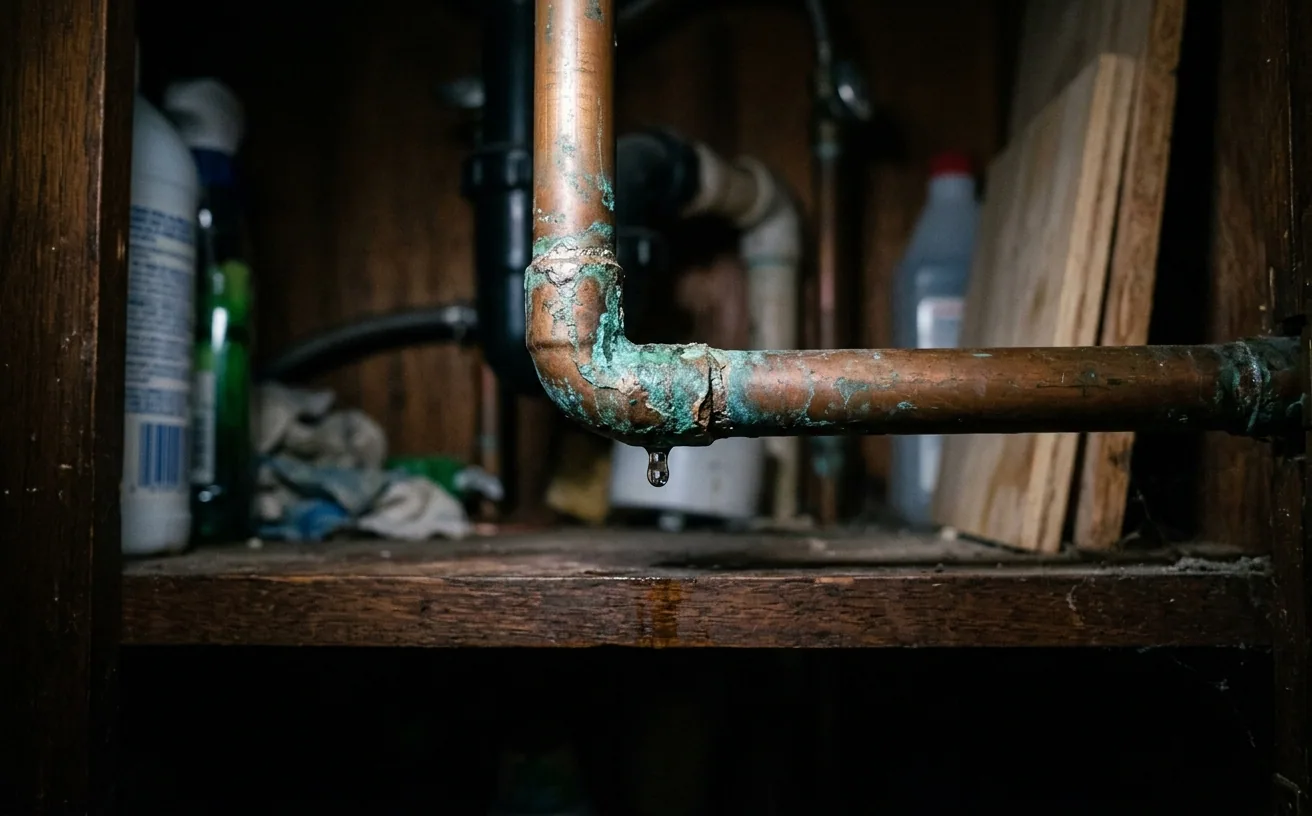
Softener leaks usually start as a slow weep at the control valve, where seals have worn. Hard water accelerates that wear on moving parts. Caught early it is a seal kit, and ignored it soaks a garage floor.
The photographs used here are generated illustrations of the conditions described. Images of our own repairs will be published once they are approved for use.
That is worth ruling out first and costs you nothing. If the level genuinely never drops, the problem is not supply. The unit is not using what is already in there.
A tank that looks full can also be bridged, with solid salt arching over empty space. Both cases look identical from the doorway. Someone has to break the crust and check underneath.
Early failures are common on units sized for average national hardness rather than for 16 grains per gallon. An undersized unit regenerates far more often than it was designed to.
That is mechanical wear brought forward, not bad luck. Repairing it is usually still correct. The capacity question is worth answering so the same failure does not repeat.
It might. The honest test is the age of the resin bed against the cost of the part that failed. Both numbers should be said out loud before you decide.
A control valve fault on a unit under about ten years old is normally a repair. A distributor failure sending resin beads into your plumbing usually is not.
Checking the bypass lever, the power and the clock is homeowner work. We will talk you through those on the phone rather than driving out.
Opening a control valve is different. The unit is under line pressure and the internal parts are small and ordered. Reassembling in the wrong sequence turns a seal job into a new valve.
The published ranges on this page make the comparison visible before anyone knocks on your door. That is deliberate.
When a repair is the better buy we will say so. When it is not, we will explain which specific part and which specific age makes it a poor bet.
We cover water softener repair in every part of the valley listed below. Each area page names the office that issues the plumbing permit there and who owns the sewer line at the curb, because both genuinely differ from one city to the next.
Say it is about this when you call and you skip the sorting.
We are a service area business. We come to you, so there is no counter to visit and no street address on this page. The number above is the fastest way in.
About a minute of detail changes what we can tell you on the call.
Three answers cover most cases. A bypass valve left open is one. A hardness setting that no longer matches the published 16 grains per gallon is another. The third is a resin bed that has lost capacity with age. A hardness test either side of the unit separates them quickly.
A fourth possibility is that regeneration happens but no brine is drawn. That is an injector or brine valve problem. The salt level sits still while the unit still runs its cycle noisily on schedule.
Standing water above the salt normally means the unit is not drawing brine back out during regeneration. The usual causes are a plugged injector, a stuck brine valve or float, or a restricted drain line. Any of the three leaves the salt untouched.
A small amount of water at the bottom of the tank is normal in most designs. It becomes a symptom when the level is high, stays high, and the salt above it is not being consumed.
A salt bridge is a hard crust of salt fused into an arch across the brine tank, leaving an air gap underneath. The water below never contacts salt. No brine is made, so the water goes hard while the tank still looks full.
Pushing a broom handle gently through the crust in several places collapses it. Never strike the tank walls and never use anything sharp. If it keeps recurring, the salt type or the garage humidity is the real problem.
Nightly regeneration usually means the control head lost its programming, often after a power interruption. It then reverts to a fixed time schedule instead of metering your actual water use. The result is a noisy cycle you did not ask for.
It can also mean the hardness setting is far too high, or the capacity setting far too low. Either way it wastes salt and water. It also shortens the life of both the valve and the resin.
Check three places before assuming it is. The control head seals, the connections at the bypass, and the drain line where it discharges are the three spots a softener actually leaks from. All three are visible without tools, and you can check them yourself.
If all three are dry, look at the water heater standing nearby and at the slab itself. Water travels across a garage floor, so the puddle is often nowhere near its source.
Most control valve faults are repairable. Pistons, seals, spacers, injectors and brine valves are common parts across the main valve families used in residential units. That is why a repair rarely depends on the badge on the tank. Parts supply is the real question, not the brand.
There are three exceptions. A cracked pressure tank, a failed internal distributor sending resin into the plumbing, and an obsolete valve with no parts still made. Those push the conversation toward replacement.
Work is not limited to a single brand. Most residential units use one of a small number of control valve families, and their wear parts are widely available. That is what makes brand neutral service realistic rather than a slogan.
We claim no approved service status, no certification and no partnership with any manufacturer. None of those relationships has been verified for this business, so none of them is stated anywhere here.
A resin bed typically lasts 10 to 15 years. Valve wear parts are consumables and can need attention well before that. On water this hard, earlier attention is the norm. That is normal wear rather than a defect in the unit.
Las Vegas conditions shorten both ends of that estimate. Hardness at 16 grains per gallon and free chlorine at an average 0.99 parts per million both work against the resin.
Describe what is happening and we will tell you what it usually takes to fix.