Plumbing and water treatment across Clark County. Call (725) 337-3692

The lateral belongs to the property ownerSpot repair and full replacementDigging through caliche, planned first

Sewer line repair and replacement for Las Vegas and Clark County

In the Clark County Water Reclamation District, the lateral from your house to the street main belongs to you. Repairing it is excavation work, so the plan matters as much as the pipe.

  • Permit pulled where the county requires one
  • Camera footage before any excavation is priced
  • Restoration discussed before the first cut
Sewer Line Repair and Replacement in Las Vegas, Nevada
Illustrative image, not a photo of our work
2,200 milesPipeline the Clark County Water Reclamation District runs
$1,388 to $5,323Published market range for sewer line replacement
50 to 60 yearsLife of cast iron waste pipe below ground
1999Median year a Clark County home was built

Figures above are published third party data, not company claims. Sources: Clark County Water Reclamation District, HomeAdvisor cost guides, InterNACHI life expectancy chart, US Census ACS via Census Reporter.

  • The lateral is the owner's pipeThe Clark County Water Reclamation District puts cleaning, repairing and replacing the lateral on the property owner.
  • Permits go through your jurisdictionUnincorporated addresses go to Clark County Building and Fire Prevention at 4701 West Russell Road, and cities run their own departments.
  • Caliche is priced in, not discovered laterA hard calcium carbonate layer sits under valley soil, and it slows every excavation that has to get through it.
  • Footage before a shovelNo excavation is quoted here without camera evidence showing where the defect is and how deep the line runs.
The short answer

Sewer line repair means fixing or replacing the buried lateral that carries waste from your house to the main in the street. In the Clark County Water Reclamation District area that pipe is the property owner's responsibility. Published market ranges run $600 to $1,050 for a spot repair. Call (725) 337-3692.

This page covers sewer line repair and replacement across the Las Vegas Valley. If you are not sure this is the right service, start from every service we cover.

What a failing sewer lateral looks like from inside the house

A failing main line rarely announces itself with a single dramatic event. It shows up as a pattern of small things that share one feature: they involve the lowest drains and they get worse over months.

The lateral runs from under the house, across the yard, to the main in the street. Everything in the building empties into it, which is why symptoms appear in more than one room.

  • Every toilet in the house gurgles when the washing machine drains
  • Water comes up through the shower pan in the lowest bathroom
  • There is a patch of grass in the front yard that is greener than the rest
  • The yard smells like sewage after we run a lot of water
  • The main line has been cleared three times this year and keeps coming back
  • There is a dip in the driveway that was not there two years ago
  • The cleanout in the side yard is full of standing water
Is this you?

If more than one fixture backs up and the lowest drains are involved, the shared line is the likely cause. That is the lateral until a camera proves otherwise.

It is also the right page when a camera run has already found a break or a separated joint. A belly or heavy root intrusion in the buried line counts too.

If only one fixture is affected and everything else drains normally, you almost certainly have a branch problem rather than a lateral problem.

When this is the wrong page

Nobody should price a repair on a line nobody has seen. If you have symptoms but no footage, start at sewer Camera Inspection in the Las Vegas Valley.

If the line is intact but coated or root filled, cleaning may be all it needs, and that is covered on hydro jetting across Clark County.

Where the pipe has not collapsed, lining it from the inside can avoid most of the digging described here. That option is explained on trenchless Sewer Repair in Las Vegas.

Clean water appearing under a slab is a supply line problem, not a sewer problem, and that belongs on slab Leak Repair in Las Vegas.

What a sewer line repair job actually involves

Excavating a lateral is a sequence of controlled steps, and most of the cost sits in the ground rather than in the pipe itself. The pipe is inexpensive. Getting to it, and putting the surface back, is not.

The parts of an open cut sewer repair in the Las Vegas Valley
What is includedWhat that means
Locating and markingThe camera head carries a transmitter so the line can be traced from the surface, giving a path and a depth before anything is dug.
Utility clearanceOther buried services have to be marked before excavation, because gas, water and electrical share the same front yard.
Permit where requiredCounty code exempts repairing a leak in drain, soil or waste pipe, and replacing or rearranging concealed piping is a different matter.
ExcavationA trench is opened to the depth of the line. Valley excavation often has to break through caliche, which is about as hard as concrete.
Pipe workThe failed section is cut out and new pipe is installed with proper fall. The whole run is replaced instead when defects are spread along it.
Backfill and compactionThe trench is refilled in layers and compacted, because loose fill settles later and pulls the new line out of alignment.
Surface restorationConcrete, pavers, irrigation and landscape are put back, and the extent of that work is agreed in writing before digging starts.
What this work looks like

The parts and conditions behind sewer line repair and replacement

Sewer Line Repair and Replacement in Las Vegas, Nevada
Illustrative image, not a photo of our work
What we commit to

What we will put in writing before digging

Excavation is the job where vague scopes hurt people, so these are specific.

  • Located and marked before quotedThe line is traced and its depth recorded before an excavation price is given, because guessing at depth is guessing at the price.
  • Restoration is named in the scopeWhat gets put back, and to what standard, is written down before the first cut rather than negotiated in a trench.
  • The permit question is answered plainlyYou are told whether your specific work needs a permit in your jurisdiction, and who is responsible for pulling it.
  • Footage at the end, not just the startA final camera pass through the repaired line is part of the job, so you can see what you paid for.
How it works

How a lateral repair is planned and carried out

The order is deliberate: see it, locate it, permit it, dig it, prove it.

  1. Show the evidence and set the scope

    You see the camera footage of your line and where the defect sits. The plumber marks the location and depth on the surface, which is what turns a vague problem into a measurable job.

    Before anything is priced
  2. Choose spot repair or replacement

    You decide between fixing one failure or replacing the run, with the reasoning laid out. One break in otherwise sound pipe is a spot repair, while repeated defects along the length argue for replacement.

    At the planning stage
  3. Handle the permit and the locates

    You confirm which jurisdiction your address sits in. Unincorporated county, Las Vegas, North Las Vegas, Henderson and Boulder City each run their own building department. Utility locates are arranged before excavation.

    Before any work starts
  4. Excavate, replace, backfill

    You keep vehicles and pets away from the work zone for the duration. The trench is opened, the failed section is replaced, and the ground is backfilled in compacted layers.

    During the work
  5. Inspect, test and restore

    You get a final camera pass showing the repaired line, and any required inspection is completed before the trench is closed for good. Surface restoration follows what was agreed at the start.

    At completion

The price becomes final once the line is located and the depth is known. Depth and surface type are the two variables that move an excavation number most.

What it costs

What sewer line work costs in this market

Excavation is the widest priced work on this site, because no two laterals sit at the same depth under the same surface. The ranges below are published guide figures, not our prices.

Sewer replacement is commonly priced per linear foot, at roughly $60 to $250 per foot. The published national average is near $3,319 for a full job. The spread is wide because depth, surface and access vary enormously.

How the estimate works

A sewer estimate starts with footage and a locate. Someone runs a camera and traces the line from the surface. The record includes how deep it sits and what is on top of it, whether turf, concrete or driveway.

That information produces a written scope: length of pipe, depth, restoration included, and permit responsibility. The price is agreed before excavation begins, and changes only if the ground reveals something the camera could not show.

Published market ranges for sewer lateral work and the diagnosis behind it
JobTypical Las Vegas rangeWhat moves the number
Sewer line spot repair$600 to $1,050One broken or cracked section, dug and replaced.
Sewer line replacement$1,388 to $5,323National average about $3,319, commonly priced at $60 to $250 per linear foot.
Trenchless pipe lining, CIPP$90 to $250 per footAn option when the pipe has not collapsed. It costs more per foot and less in restoration, so the comparison is total, not per foot.
Sewer camera inspection$100 to $500That is the range when it is run as part of diagnosing a sewer problem. A standalone full survey runs higher.

Every figure in this table is a published Las Vegas or national market range from the source named beside it. It is not a quote and it is not this company's price list. Your number comes from the on site estimate. Sources: <a href="https://www.homeadvisor.com/cost/plumbing/" rel="nofollow noopener" target="_blank">HomeAdvisor cost guides, 2026</a>.

What changes your number

  • Depth is the strongest driver, because a line six feet down needs a wider trench and more shoring than one three feet down.
  • What sits above the pipe matters just as much, and cutting through a concrete driveway adds both demolition and replacement to the job.
  • Caliche under valley soil can be about as hard as concrete, and breaking through it slows an excavation that would be routine elsewhere.
  • Length of the run scales the price directly, since the market commonly prices replacement between $60 and $250 per linear foot.
  • Tree roots complicate a dig because mature roots have to be cut and removed without destabilizing the tree or the trench wall.
  • Restoration scope can add substantially, and irrigation lines, pavers and mature landscape are the items most often underestimated.
Repair against replace

A spot repair on one failed section sits in the high hundreds to low thousands, while replacing the full lateral runs several thousand.

Service call and diagnostic fee

A camera inspection run as part of diagnosing a sewer problem is published at $100 to $500, and a standalone full survey runs higher. The trade service call fee sits at about $75 to $150 per the Housecall Pro 2026 Plumbing Price Guide.

Crediting a diagnostic fee against excavation work is not verified here, so this page does not claim it. Both the fee and its treatment are settled on the phone before anything is scheduled.

Ranges last reviewed September 2026.

What the job looks like

What actually breaks a Las Vegas sewer lateral

The median Clark County home was built in 1999, which means most valley laterals are plastic and relatively young. The failures cluster in two groups: older properties with clay, cast iron or Orangeburg pipe, and any property with mature trees over the line.

Tree roots are reported to cause more than half of all sewer blockages. The pipe most at risk is older jointed pipe running shallow near fast growing trees.

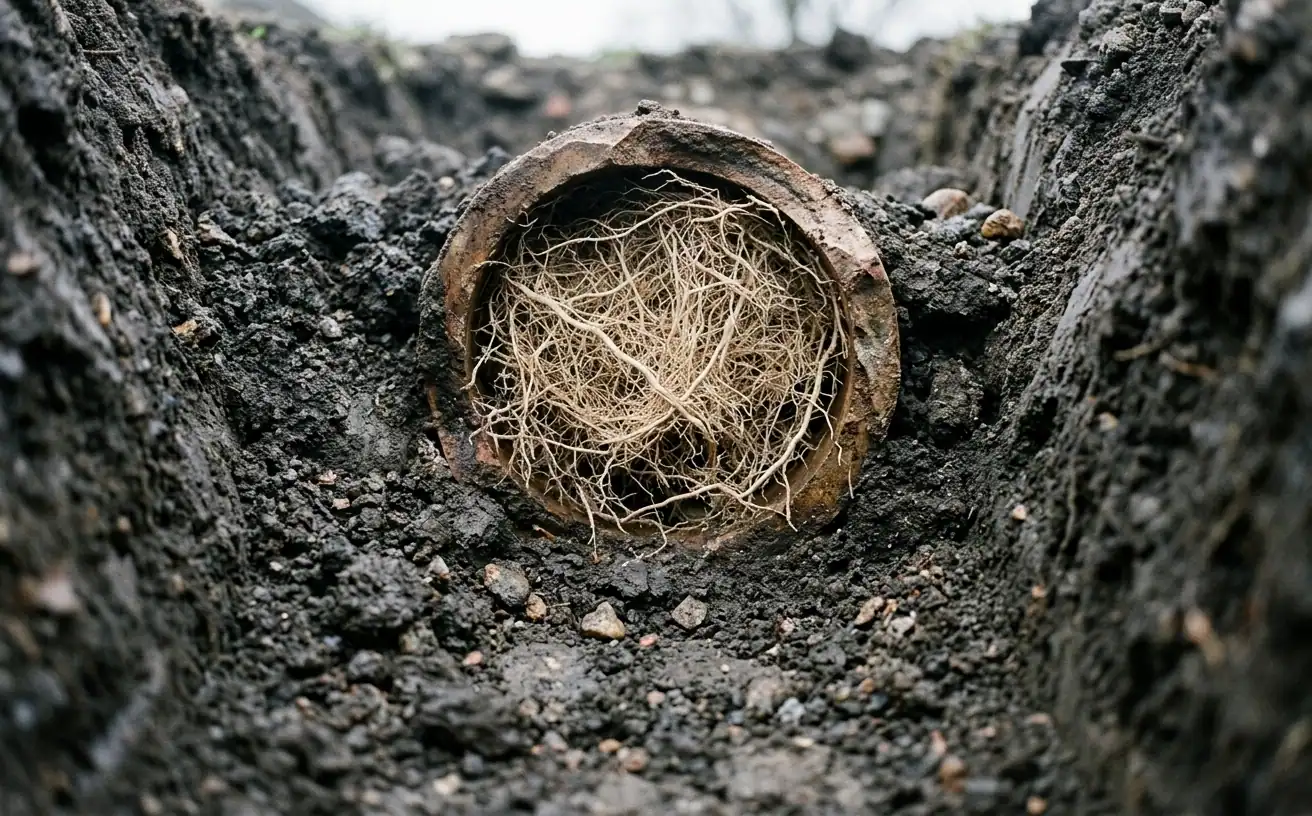
Roots entering at a joint. Sewer Line Repair and Replacement in Las Vegas
Illustrative image, not a photo of our work

Roots entering at a joint

Roots do not drill through sound pipe. They find a joint, a crack or a failed seal and grow toward the moisture inside. Once in, the root mass thickens each season and catches solids until flow stops. Cutting them restores flow without closing the opening they used.

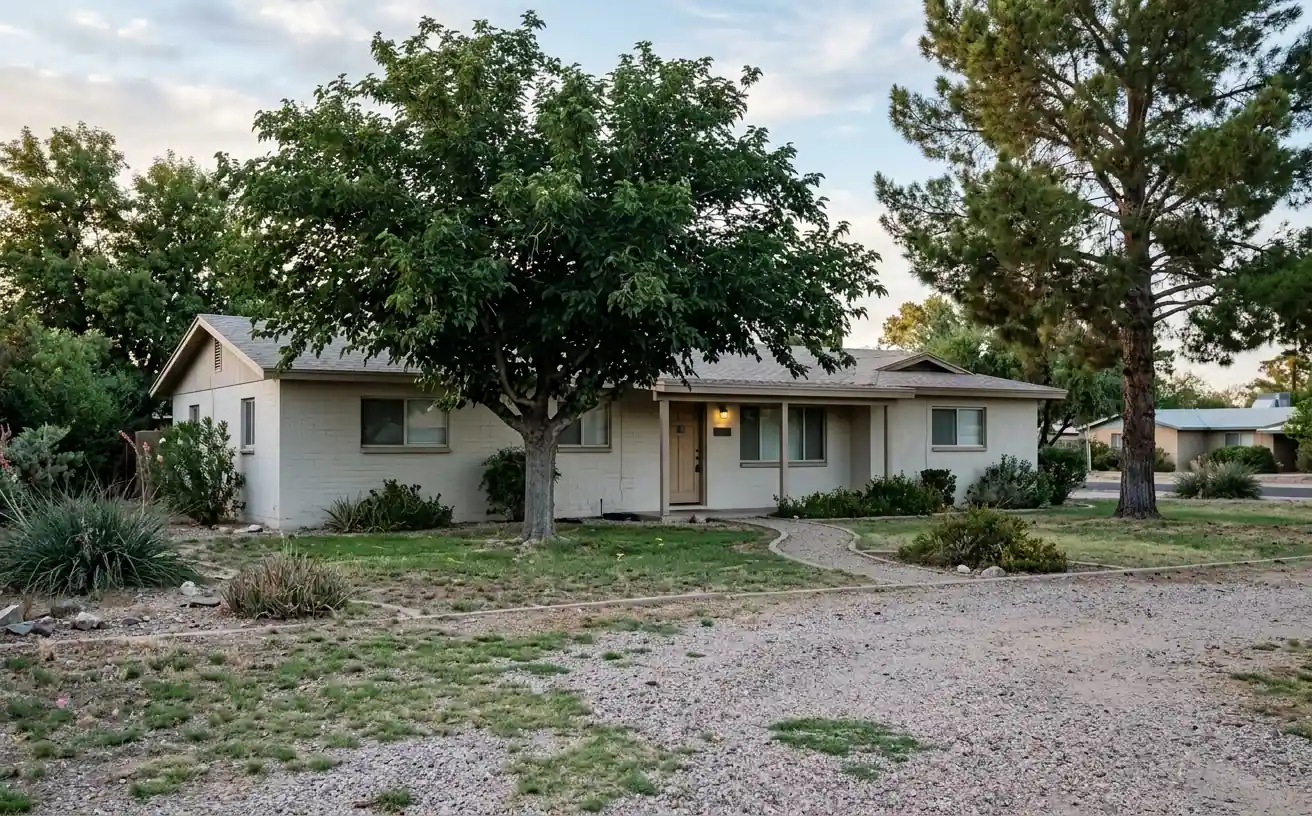
Older properties with mature landscaping. Sewer Line Repair and Replacement in Las Vegas
Illustrative image, not a photo of our work

Older properties with mature landscaping

Valley neighborhoods built before 1980 account for roughly 16.7 percent of county housing, and their trees have had decades to reach the lateral. The combination of older jointed pipe and established roots is the classic repeat backup. These are the properties where a camera pays for itself quickly.

Photography note

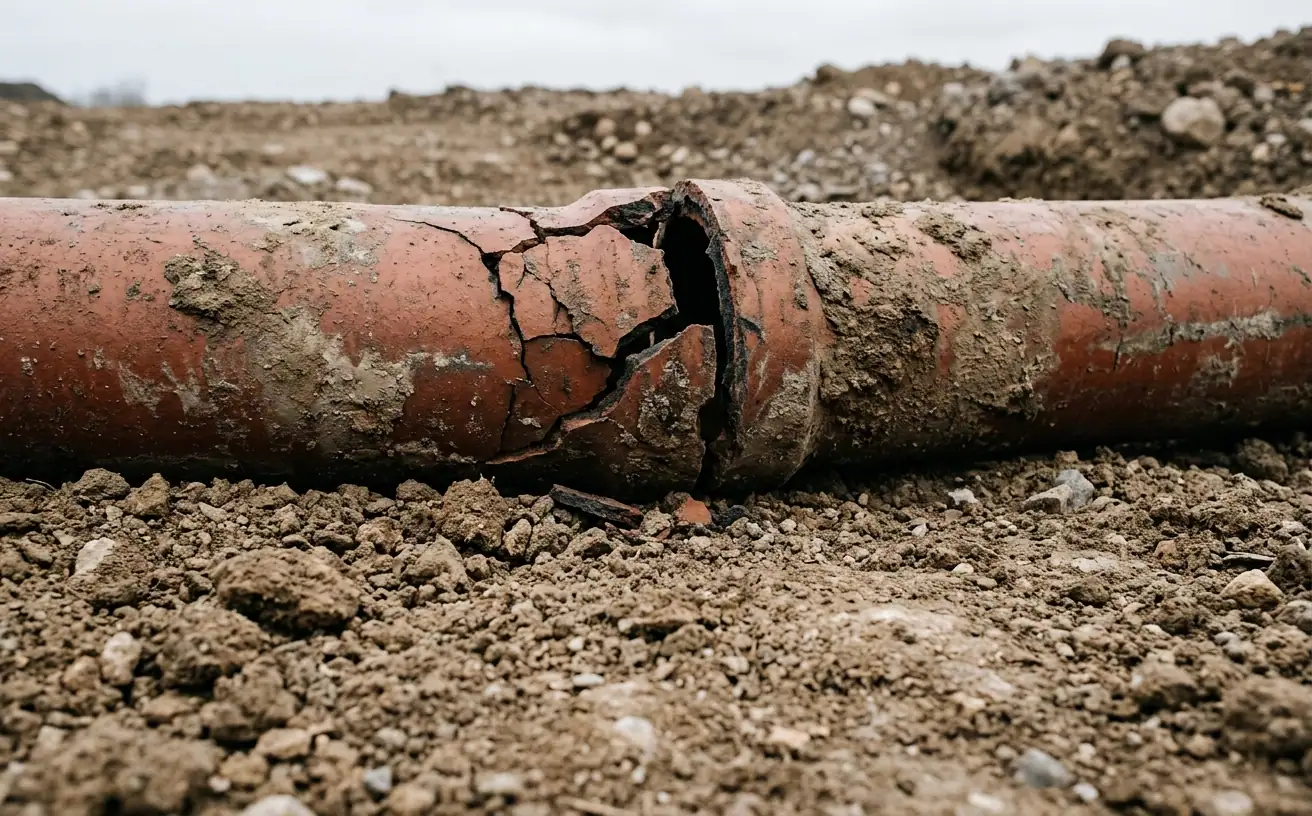
The root filled pipe and the older valley home above are illustrations of the failure pattern described here. Photographs from actual excavations are added once the property owner approves them.

The hard questions about digging up a yard

Is the sewer line not the city's responsibility?

Not the part on your side. In the Clark County Water Reclamation District service area, the lateral from the house to the street main belongs to the property owner. Cleaning it, repairing it and replacing it all fall to the owner.

The district itself operates more than 2,200 miles of pipeline for more than 240,000 accounts, and that network starts where your lateral ends. Confirm the boundary for your address before assuming either way.

Can I just keep having it cleared instead?

You can, and for some properties that is a reasonable interim plan with eyes open. Clearing is cheap compared with excavation, and a line with light root intrusion may run for years between visits.

The calculation changes when the interval shortens or when the camera shows the pipe itself failing. Repeated clearing on a collapsing line is money spent on delay rather than repair.

Do you have to tear up my driveway?

Only if the line runs under it and the repair is an open cut. Where the pipe is intact enough to be lined from the inside, most of the surface can stay where it is.

The camera and the locate answer this before any commitment. If the answer is that the driveway has to come up, you should hear it during planning, not on the day.

Do I need a permit for a sewer repair in Clark County?

It depends on the work. County Code 22.02.195 exempts stopping a leak in a drain, soil, waste or vent pipe. It also exempts clearing stoppages and repairing leaks in pipes, valves or fixtures.

Replacing or rearranging concealed piping is outside that exemption. For unincorporated addresses the department is Clark County Building and Fire Prevention at 4701 West Russell Road, reachable at (702) 455-3000.

How do I know the new pipe was installed correctly?

The two things that matter are fall and bedding. A sewer line runs on gravity, so consistent slope is what keeps solids moving. The pipe also has to sit on properly prepared material rather than rock.

Ask for the final camera pass and, where the work is permitted, the inspection result. Those two items are the practical proof, and both exist before the trench is closed.

My house is only fifteen years old, so this cannot be the sewer.

It is less likely, and it is not impossible. Newer laterals are plastic and do not corrode. They can still be crushed by settlement, misaligned at a joint or blocked by a construction defect.

About 47 percent of Clark County homes were built in 2000 or later, and bellies in newer laterals are not rare. The camera settles it either way without any digging.
Where we do this work

Sewer Line Repair and Replacement across Clark County

We cover sewer line repair and replacement in every part of the valley listed below. Each area page names the office that issues the plumbing permit there and who owns the sewer line at the curb, because both genuinely differ from one city to the next.

The fastest way in

Ask about sewer line repair and replacement

Say it is about this when you call and you skip the sorting.

Reach Clark County Plumber

Service area
Clark County, Nevada, including Las Vegas, Henderson, North Las Vegas, Summerlin, Paradise, Spring Valley, Enterprise and Boulder City

We are a service area business. We come to you, so there is no counter to visit and no street address on this page. The number above is the fastest way in.

What to have ready

About a minute of detail changes what we can tell you on the call.

  • The address and ZIP code, so we know which end of the valley you are on.
  • What the symptom is, in your own words. "Water under the sink" beats a diagnosis.
  • When it started, and anything already tried.
  • On a water heater: gas or electric, and roughly how old it is.
  • You get the diagnostic fee as a figure on the phone, before anyone is sent.
  • Scope and price are agreed together, before any work starts.
  • Water moving right now? Shut the main off first, then call and say so.

Questions about this service

Who is responsible for the sewer line between my house and the street?

In the Clark County Water Reclamation District service area, the sewer lateral is the property owner's responsibility. That covers the pipe from the house to the main in the street, including cleaning, repair and replacement. The district's own responsibility begins at the main. That division is why lateral failures land on homeowners.

If your property is served by a different jurisdiction, check with that agency directly, since boundaries and responsibilities vary. It is worth confirming before a repair, not during one.

How do I know if my sewer line needs repair or just cleaning?

Cleaning fixes what is inside the pipe, and repair fixes the pipe itself. The evidence that separates them is camera footage. Coating, grease and light roots are cleaning problems. Cracks, separated joints, sags and collapsed sections are repair problems that will not wash away.

The pattern of backups also tells you something. A line that stays clear for years after one visit was simply dirty. A line that blocks again within months usually has a defect feeding it.

How long does a sewer line replacement take?

A straightforward spot repair on a shallow line in soft ground is often a one day job. A full lateral replacement typically runs two to four days, with permit review, utility locates and surface restoration accounting for much of that time.

Valley conditions can extend it. Caliche, a hard calcium carbonate layer under the desert soil, is slow to break through. Concrete or paver surfaces add both demolition and replacement to the schedule.

What is a belly in a sewer line?

A belly is a low spot where the pipe has sagged and lost its consistent fall. Water stands in the dip instead of flowing through, so solids settle out and build up at the same point again and again. It is a classic cause of repeat blockages.

Bellies come from settlement or poor bedding under the pipe when it was installed. Cleaning empties the sag temporarily, and only re-bedding or replacing that section actually fixes it.

Does homeowners insurance cover sewer line repair?

Standard policies frequently exclude the buried lateral and exclude damage described as gradual. Coverage does vary, and some carriers sell a service line endorsement that applies to exactly this repair. Read the actual policy language rather than assuming either answer applies.

If you intend to file, document everything early. Camera footage, dated photographs and a written scope carry weight with an adjuster. A description written after the pipe is back in the ground carries much less.

What kind of pipe is used to replace a sewer lateral today?

Modern replacements are normally plastic sewer pipe sized for the run, installed with consistent fall and proper bedding. The material choice matters less than the installation, because slope and support are what keep a gravity line working for decades. Both are set on the day of the work.

The pipe coming out tells its own story. Clay, cast iron and Orangeburg all have known failure patterns. Orangeburg went in from the 1940s to the 1970s, and its pattern explains a lot of repeat backups.

Can a sewer line be repaired without digging up the whole yard?

Often yes, when the pipe is still structurally continuous. Lining the existing pipe from the inside avoids a full length trench, and so does bursting it to pull new pipe through. Either way, the work needs only access pits at each end of the run.

It stops being an option when the line has collapsed, is badly offset or has a belly that needs re-grading. Those conditions are explained on trenchless sewer repair across Clark County.

Talk to someone about sewer line repair and replacement

Describe what is happening and we will tell you what it usually takes to fix.