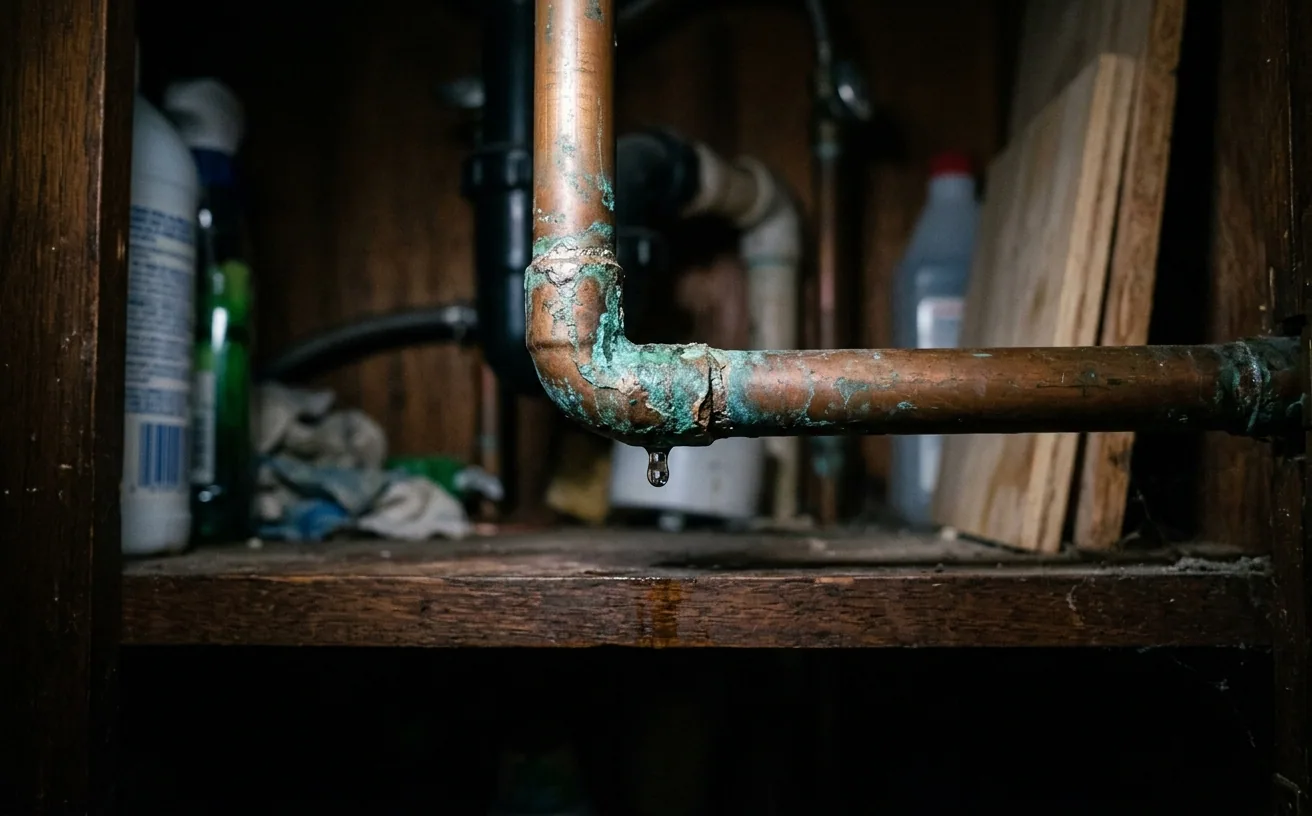
A joint that will not reseal
A weeping joint is not a tightening problem. Solder, compression and push fittings all fail at the seal, and re-tightening usually moves the leak instead of stopping it. The fitting gets cut out and replaced.
Repairs, not automatic replacementsNo permit needed for a leak repairLas Vegas and Clark County homes
A single failed joint, valve or short run of pipe is a repair, not a repipe. Angle stops under sinks and toilets generally last 8 to 20 years, and hard water pushes them toward the early end.
Figures above are published third party data, not company claims. Sources: Clark County Code, InterNACHI, LVVWD Water Quality Report.
Pipe repair fixes one failed section of plumbing instead of replacing the system. Common failures in Las Vegas include copper pinholes, corroded galvanized threads, weeping joints and worn angle stops. Clark County Code 22.02.195 lists repairing leaks in pipes, valves or fixtures as work that needs no permit.
This page covers pipe repair across the Las Vegas Valley. If you are not sure this is the right service, start from our Las Vegas plumbing services.
Pipe failures rarely start as a flood. They start as a stain, a drip, a drop in flow or a valve that will not close all the way.
The material tells you a great deal. Copper fails at pinholes, galvanized fails at threaded joints, and polybutylene fails from the inside where nobody can see it.
You have a known leak or a failing valve somewhere a person can reach, or somewhere a small opening will reach. The rest of the plumbing works fine. If that is your situation, a repair is a real option and you deserve the price for it.
A repair is the wrong answer when the whole system has reached the end of its life. If leaks keep appearing on different runs, read repiping across Clark County. If the pipe is under the concrete floor, that is slab Leak Repair in Clark County, NV. If nobody has located the leak yet, start with leak Detection in the Las Vegas Valley.
The scope is one failure plus the access needed to reach it. Anything past that is a different conversation with a different price attached.
| What is included | What that means |
|---|---|
| Copper pinhole repair | The failed length is cut out and replaced with new copper, since a pinhole means that section of pipe wall has already thinned. |
| Threaded galvanized joint | Corroded threads are cut back to sound metal and transitioned, often to copper or PEX, using the correct dielectric fitting. |
| Angle stop replacement | The small shutoff valves under sinks and toilets are replaced along with the flexible supply line, which fails at a similar age. |
| Leaking joint or fitting | Solder joints, compression fittings and push fittings are cut out rather than tightened, because a failed joint does not reseal. |
| Access and closing up | Drywall is opened where needed and left cut clean and squared, with patching, texture and paint called out separately. |
| Pressure test after the repair | The repaired section goes back under pressure and is watched before the wall is closed, so nothing gets buried untested. |
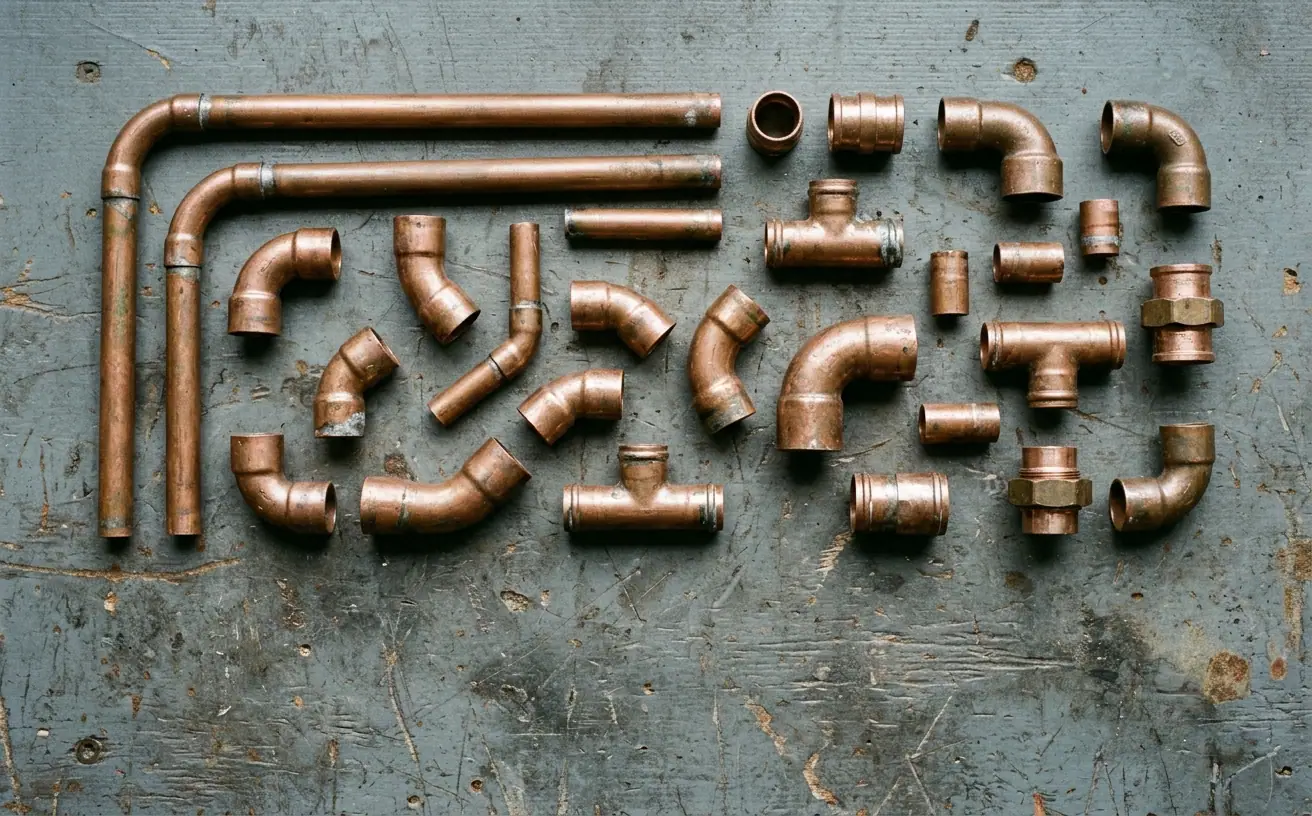
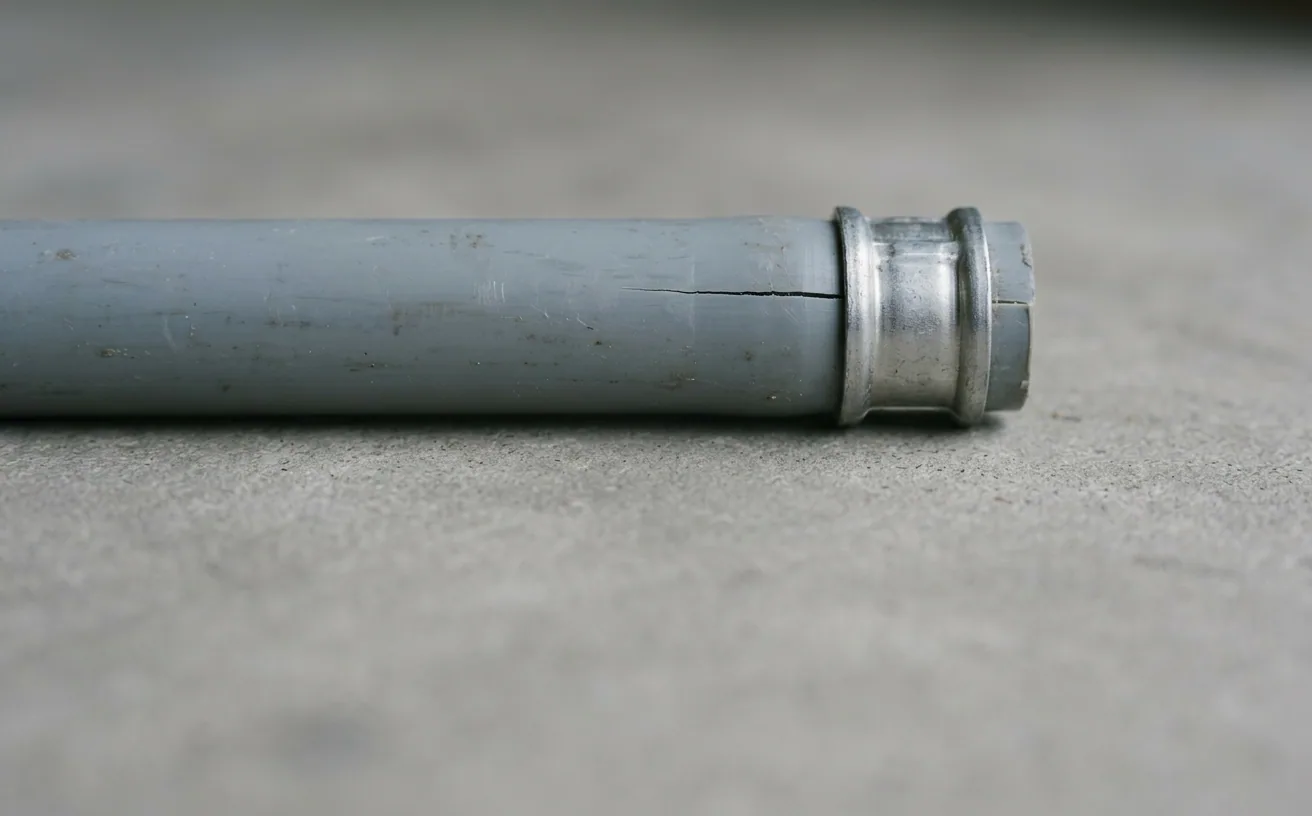
Four stages, and you know the price before the third one.
You say where the water shows and what sits above or behind it. Whoever takes the call needs the pipe material if you know it, and where the main shutoff is.
On the phoneYou point out the wet spot and clear the cabinet if there is one. The plumber opens the smallest access that reaches the failure and identifies the pipe material.
At the point of accessYou approve the scope in writing. The plumber quotes the repair, and says plainly if the material or the pattern of failures makes a repipe the better spend.
Before any pipe is cutYou check the fixture and the water pressure. The plumber replaces the failed section, pressure tests it, and leaves the access squared off for patching.
Once the written scope is approvedThe price becomes final at the written scope, once the pipe is exposed and the material is known.
Pipe repair has no single published range, so the table below carries the service call, the detection fee and the repipe comparison instead. Each names its guide.
Pipe repair is priced by access more than by pipe. The fitting itself is cheap, and the tile, the ceiling or the crawl space in front of it is what costs money.
A plumber comes to the house, opens the access, identifies the material and writes the repair. How long that takes depends on what sits in front of the pipe, not on the fitting itself.
If the exposed pipe looks worse than the symptom suggested, you hear that before more pipe is cut. The revised scope is priced and approved before the work continues.
| Job | Typical Las Vegas range | What moves the number |
|---|---|---|
| Service call or diagnostic fee | $75 to $150 | The broader trade range runs about $50 to $200. Emergency and after hours dispatch is higher, commonly $150 to $350 or more. |
| Leak detection | $125 to $400 | Repairing the pipe once it is found runs about $150 to $350 more. Las Vegas contractors commonly publish $200 to $600 for detection. |
| Pressure regulator replacement | $200 to $700 | Average around $400. |
| Whole home repipe, PEX | $4,000 to $10,000 | Las Vegas contractors commonly publish $4,500 to $8,000 for 1,500 to 2,000 square feet, rising with the size of the house. |
Every figure in this table is a published Las Vegas or national market range from the source named beside it. It is not a quote and it is not this company's price list. Your number comes from the on site estimate. Sources: <a href="https://www.housecallpro.com/resources/marketing/how-to/how-to-price-plumbing-jobs/" rel="nofollow noopener" target="_blank">Housecall Pro 2026 Plumbing Price Guide</a>, <a href="https://www.homeadvisor.com/cost/plumbing/" rel="nofollow noopener" target="_blank">HomeAdvisor cost guides, 2026</a>, <a href="https://www.angi.com/articles/how-much-does-repiping-house-cost.htm" rel="nofollow noopener" target="_blank">Angi cost guides, 2026</a>.
One pinhole in a healthy copper system is worth repairing, while a third pinhole in two years means the system itself is finished.
Published guides put a plumbing service call or diagnostic fee at about $75 to $150, with the broader trade range from $50 to $200. That covers getting a plumber to the house and identifying the problem, not the repair itself.
On a small repair the diagnostic fee is a real share of the total. The credit rule matters more here than on a big job. This page cannot confirm one, so ask for it when you book the visit.
Ranges last reviewed September 2026.
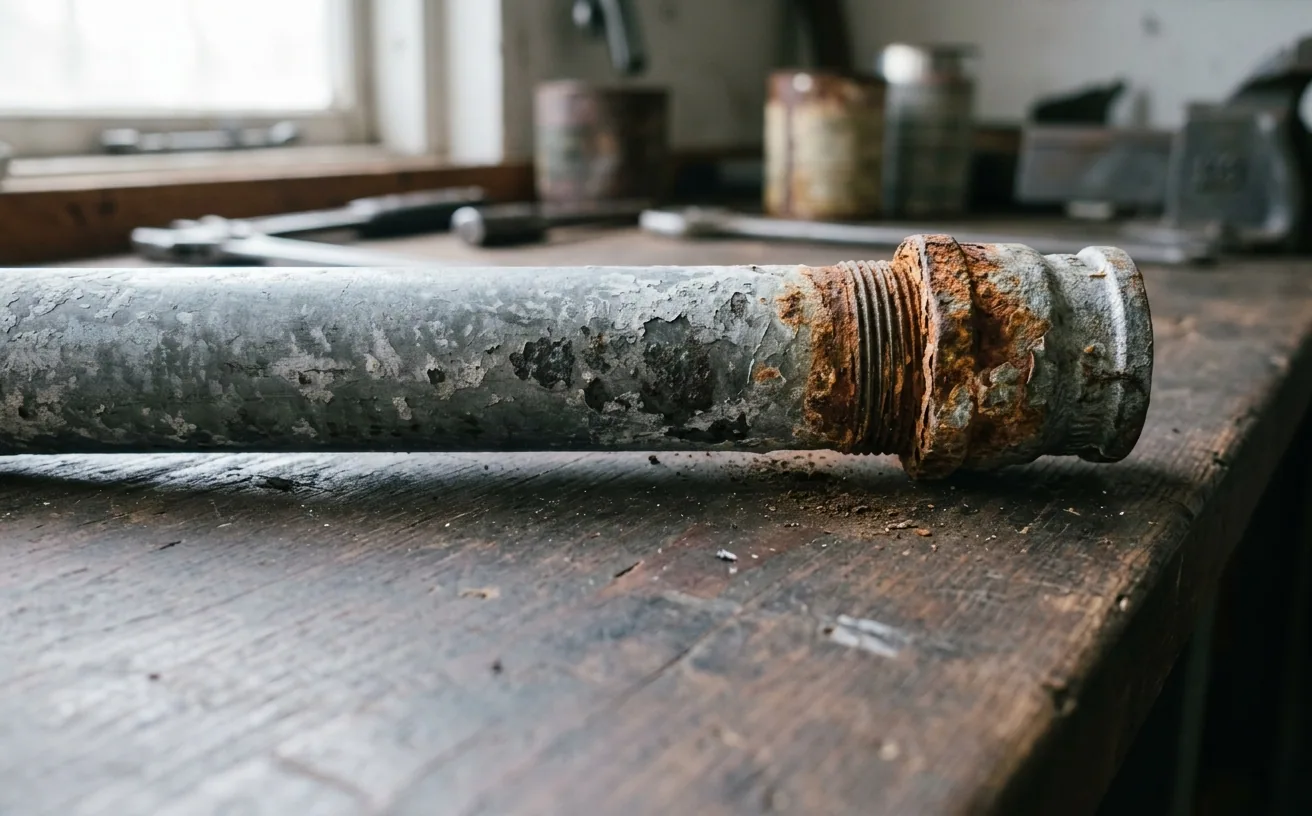
These illustrate the failure modes described above. They are drawn to show the mechanism a plumber is looking at when a section is cut out.
A weeping joint is not a tightening problem. Solder, compression and push fittings all fail at the seal, and re-tightening usually moves the leak instead of stopping it. The fitting gets cut out and replaced.
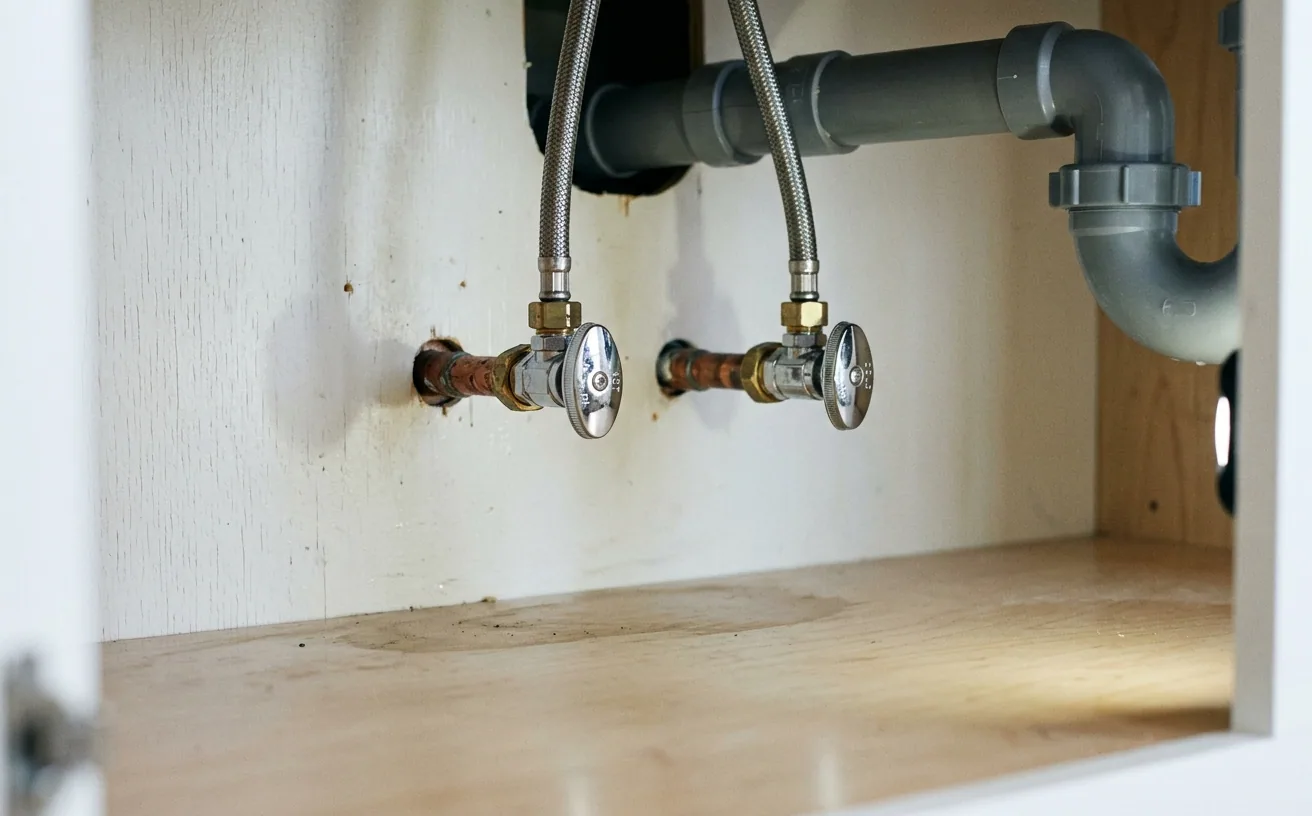
These small shutoff valves sit under every sink and toilet in the house. InterNACHI puts their life at 8 to 20 years, and hard water pushes them to the early end. A stop that will not close is the repair you want done before it matters.
Both pictures above are drawings of a failure mode, not a customer's pipe. A photograph from a real job goes in each slot as soon as one can be published.
On a compression nut, sometimes, and it is worth trying before anything gets cut. On a solder joint or a corroded thread, no. Tightening a failed joint usually moves the leak a few inches rather than stopping it.
Because a pressurized leak has to be seen to be repaired properly. A small clean opening also costs far less to patch than the damage from guessing wrong. The opening is cut square and kept as small as the fitting allows.
Sometimes, as a stopgap, and you should hear it framed that way. InterNACHI puts galvanized life at 20 to 30 years, so a 1970s line is decades past that. A repair buys time while you plan, not a solved problem.
A single fitting can be repaired, but polybutylene fails from the inside along its whole length. It was made from 1978 to mid 1995 and is usually stamped PB2110. The class action settlement closed long ago, so replacement is the owner's cost.
For repairing a leak in a pipe, valve or fixture in unincorporated Clark County, no. Code 22.02.195 lists that work as exempt, as long as concealed piping is not replaced or rearranged. Replacing a run inside a wall is a different case.
We cover pipe repair in every part of the valley listed below. Each area page names the office that issues the plumbing permit there and who owns the sewer line at the curb, because both genuinely differ from one city to the next.
Say it is about this when you call and you skip the sorting.
We are a service area business. We come to you, so there is no counter to visit and no street address on this page. The number above is the fastest way in.
About a minute of detail changes what we can tell you on the call.
A repair fixes one failed section, joint or valve and leaves the rest of the system in place. A replacement takes out a whole run or the whole house. The dividing line is how many failures the same system has produced and how old the material is.
A single pinhole in copper is a repair. A third pinhole on the same line in two years is a system telling you something.
There is no single published range, because the price follows the access rather than the pipe. Published guides put the service call at $75 to $150 and a leak repair after detection at roughly $150 to $350. Behind tile or in a ceiling, the number climbs.
Get the quote after the pipe is exposed and before it is cut. That is the only moment when anyone can price the work honestly.
Pinhole corrosion comes from water chemistry, velocity and installation detail together. Valley water is published at 280 parts per million hardness with a saturation index of plus 0.25, meaning it deposits scale. Scale narrows the bore, raising velocity and wearing thin spots.
Hot lines usually go first. Heat accelerates both scale formation and the chemistry that drives the corrosion behind a pinhole.
No, not for the repair itself in unincorporated Clark County. Code 22.02.195 lists stopping leaks, clearing stoppages and repairing leaks in pipes, valves or fixtures as work needing no permit. That holds so long as concealed piping is not replaced or rearranged.
Each jurisdiction runs its own desk. Unincorporated county permits come from Building and Fire Prevention at 4701 West Russell Road. Henderson, Las Vegas, North Las Vegas and Boulder City each have their own.
Most single point repairs take one to two hours once the pipe is exposed. Cutting the access, replacing the section, pressure testing and cleaning up fit into a single visit. A repair behind tile or inside a ceiling can stretch to half a day.
Water is off for part of that. Expect the main to be shut for roughly 30 to 90 minutes on a typical repair.
Often yes, and it is a cheap addition when the water is already off. InterNACHI puts angle stop life at 8 to 20 years, and Las Vegas hardness pushes that toward the early end. A stop that will not close turns a small leak into a big one.
The flexible supply line usually gets replaced with it. They age together, and both cost very little next to the labor of a second visit.
A homeowner can work on their own home in Nevada, but the exemptions are narrower than people assume. The owner builder exemption requires an affidavit filed with the building department and direct supervision of the work. The small job exemption under $1,000 does not apply when a permit is required.
The practical risk is not legal, it is water. A failed repair inside a wall runs while you sleep, and that damage costs far more than the visit would have.
Describe what is happening and we will tell you what it usually takes to fix.